rebeccmeister: (Default)
I could SLEEP last night, FINALLY, because some spring rainfall finally brought blessed, blessed, sinus relief. WHEW.

Tuesday, as usual, has been exceptionally busy. The kids students did well with the lab, though, which was great.

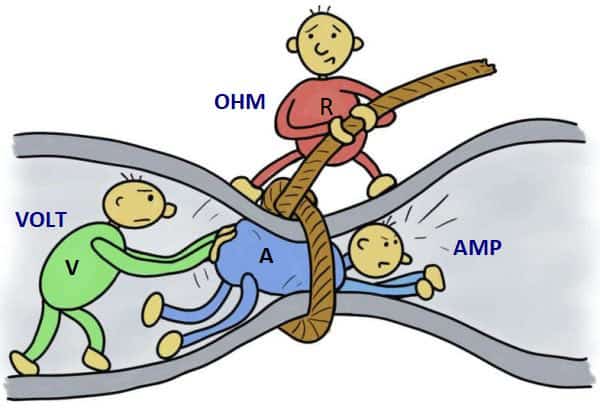
This is the best cartoon depiction for Ohm's Law, by the way: https://www.circuitbasics.com/wp-content/uploads/2020/08/Ohms-Law-cartoon.jpg

Our lab involved characterizing/quantifying sodium transport rates across a tissue surface (frog skin, in this instance). Long story short, there's a method that can be used to "short circuit" the tissue, where the measured current will then be directly proportional to the rate of sodium transport. Handy!

It has taken me YEARS to figure out how to get this lab to run well. Thank goodness it now does.

But now, time for more sleep.
rebeccmeister: (Default)
What's the difference between am entomologist and an etymologist?

I don't know, and it bugs me in a way I can't put into words.

So, Sunday was the Eastern Branch Meeting of the Entomological Society of America, which took place in a town north of here. It was close enough to campus that my research students were excited about the idea of being able to go and present their research, so they did! Here's the busy poster hall in the midst of the poster presentations:

Entomology Eastern Branch Meeting and Bug Expo

The meeting organizers also organized a Bug Expo event to accompany the conference, and I said we could put together an ant activity table for the Bug Expo, too. That meant that I got up extra early Sunday morning to drive to campus and assemble supplies for our table. We did bring along some hissing cockroaches, too, just for solidarity.

Here's a picture of the convention center rooms where our Expo took place:

Entomology Eastern Branch Meeting and Bug Expo

By sheer coincidence, there was another, larger Expo taking place on the main floor of the conference center, too, showcasing sports and other active lifestyle things to do in Upstate New York. Ultimately, I think the fact there were two expos happening meant that both expos got more traffic. We were definitely busy for the entire day, to the extent that I never made it to any of the conference talks at all.

Our most popular item was our offering of ant stamp temporary tattoos. I had a lot of fun amending this person's spider tattoo (although the ant wound up being fainter than intended):

Entomology Eastern Branch Meeting and Bug Expo

The item with the black cloth over it was to add intrigue around our display of The Largest Ant in the World?? We had fun pulling out the ant to show it to people (Dinomyrmex gigas). I was also pleased with how the "What's in an Ant Colony?" display poster and stand turned out. We'll be able to reuse that for other outreach events in the future.

Entomology Eastern Branch Meeting and Bug Expo

There were lots of other great insect- and arthropod-themed things on display, like this insect origami station where people could fold their own cicadas and butterflies:

Entomology Eastern Branch Meeting and Bug Expo

The people with these Bessie Bugs (Bess beetles, family Passalidae) had a series of creative interactive activities to foster appreciation for the beetles (and beyond):

Entomology Eastern Branch Meeting and Bug Expo

I appreciated the display on how to handle the beetles, "Hold it like you are picking up a piece of candy."

Entomology Eastern Branch Meeting and Bug Expo

Our table neighbors come from a biodiversity research farm/site a bit to the south of Albany:

Entomology Eastern Branch Meeting and Bug Expo

It was great to see them, because I'm hoping to go and pay them a visit once the weather warms up a bit. As part of their suite of biodiversity surveys, they have been surveying ant diversity across a range of sites, from a site they consider "ancient forest" (no signs of any human occupation, ever), to sites planted with a range of different types of vegetation, including pollinator-friendly mixes or more conventional agricultural plantings.

There were also people who run a business for creating insect-friendly garden landscapes, who had a great display highlighting all of the kinds of spaces that different kinds of insects like to use:

Entomology Eastern Branch Meeting and Bug Expo

A grad student group also participated, selling a bunch of different insect-themed wares to raise funds for student support. The gray crocheted mosquitoes were hilarious. They also had beetle elytra earrings for sale, so I finally bought some. So shiny.

Entomology Eastern Branch Meeting and Bug Expo

As to be expected, some of the outreach was in the name of biocontrol. Apparently someone got funds some time ago to have insect/arthropod mascot costumes made for an Asian longhorn beetle and for an anatomically accurate tick:

Entomology Eastern Branch Meeting and Bug Expo

Entomology Eastern Branch Meeting and Bug Expo

Somewhat inexplicably, there were a bunch of reptiles, snakes, and raptors at the Bug Expo, too.

Entomology Eastern Branch Meeting and Bug Expo

We only made it over to see the raptors shortly before the Expo wrapped up. The raptor handlers said that they were participating because certain raptors (and the other reptiles, I suppose) eat insects. I suppose so.

Entomology Eastern Branch Meeting and Bug Expo

In addition to the ant tattoos, we also folded and handed out a ton of ant zines, maybe around 85 of the 100 I photocopied. All told, a good and productive day, but also exhausting.
rebeccmeister: (Default)
Today was the day before spring "break," wherein I administered the first of two midterm exams. Students reported they had a lot of exams this week, which we all agreed was not ideal but better than trying to have an exam immediately after spring break.

Since my afternoon office hours were very quiet, I was able to spend a good part of the afternoon working on data entry for a project that two of my current three research students are working on. We are looking at what happens to worker ant body sizes as leafcutter colonies get older and larger, comparing colonies headed up by two queens to colonies headed up by groups of six queens. Since starting those colonies back in the summer of 2024, students and I have periodically gone through and collected out the colonies' trash piles, which contain all of the dead workers - a noninvasive way to examine adult ant body sizes.

Cataloguing what has been done with the colonies since their establishment led me to realize we'd overlooked a set of samples that could be particularly informative to include. So although I was quite tired, in the last 30 minutes of the day, I finally located the samples and started to get them ready for measurements.

It is much more fun and rewarding to apply ant heads to a piece of double-sided sticky tape for the purpose of measuring how big they are than it is to grade exams, so most likely that's what I'll work on for the first part of the day on Monday.
rebeccmeister: (Default)
Yesterday at the very end of a quite full day, as I was finishing up a rewrite of the first Animal Physiology exam, a colleague knocked on my door to ask for help with a surprise shipment of sea creatures. I'd been maintaining our large flow-through saltwater tank with the idea that even if I didn't move the horseshoe crabs over into it, it would still be useful to have it ready to go as a backup and for the couple-week period when students in General Biology are learning about marine invertebrates.

And really, what's more fun, writing an exam, or rehousing the marine invertebrates?

This batch unfortunately arrived a month too early, so they may not all survive until it's time for students to work with them. So we'd better enjoy them now, while we can. Another batch is apparently supposed to arrive on time.

It's hard to take photos through running water, but here are a sea pansy (purple, upper left), urchin, and red-footed sea slugs:

Unexpected sea critters

This is some sort of wee ghost crab:
Unexpected sea critters

We got a decorator crab with this batch, too! So cute!
Unexpected sea critters

As I watched, the ghost crab decided to go and antagonize the decorator crab:
Unexpected sea critters

Crabs be crabbin'. So I put the decorator crab into its own separate little container.

One of the tubs, overall:
Unexpected sea critters

The tube delivers water into the tub, and the overflow drips out into the main basin of the flow-through tank. This is a pretty good setup for ensuring the water stays well-oxygenated.

When I came back in this morning, the power to the flow-through pump was out, and I also realized it's maybe not a good idea to have the bivalves in with the predatory whelks, so I moved the tiny clams over to a separate tub.

Hermit crab on top of some sort of giant barnacle:
Unexpected sea critters

If you look closely, you might notice that this hermit crab's shell has a wee anemone on it. So cute!

Sponges, snails, and an urchin, oh my! And yes, another hermit crab, if you look closely again.
Unexpected sea critters

I got home pretty late from the surprise animal rehousing, so in turn I once again failed to get up for rowing practice, sigh. This has just been a rough week.

Today it would be way more fun to spend the day trying to draw these critters, instead of what I should be doing, which is using this precious time to work on manuscript-writing.

But manuscript-writing it is. Eyes on the prize, or something.
rebeccmeister: (Default)
We definitely read T.S. Eliot's poem in high school, and it definitely fills me with a certain sense of glee, just to to think of it.

Also ever since I learned of it, I've been cognizant of the fallacy of relative privation, which is helpful for appreciating that my grumblings still have legitimacy even while people in Ukraine and elsewhere are experiencing hardships far beyond my own.

Anyway, work. Even with a much smaller class size, Tuesdays are long, tough days, because there are still 2, 4-hour labs, back-to-back. Especially the Tuesdays where I have rowing meetings right after lab, such that I get home late and all I can do is try to eat something and crawl into bed, the cats unhappy because no one has been at home to play with them. So I'm just feeling like it's very much the middle of the semester, where it's hard to do much of anything outside of the daily grind, and the daily grind rarely imparts a sense of net progress. We do have spring "break" next week, so at least I'll have a chance to get caught up on grading.

I think maybe one of the hardest parts is getting hit by those moments of, is this what my life is going to be? There is net good, but there is also so much tedium, even on the college level. I know I'll get through, but damn, work is a lot of work. Just remember that when you talk to educators.

On that note, time to get back on the road to campus.
rebeccmeister: (Default)
Since we are 150 miles north of Manhattan, we are not getting impacted by the current blizzard to the same extent as the city. Nonetheless, we're seeing a fair amount of snow and blustery wind, and this time at least my institution decided to cancel all classes up through noon. They issued the cancellation message last night at 9 pm, which made for a pretty quick pivot for me. In turn, I canceled my plans to try and go to rowing practice this morning, and instead got up early to start making Even More Lecture Videos for Animal Physiology.

The problems are, videos are large files, and my home upload speed is pretty throttled, so it has taken almost an hour to upload the first, shorter video (~1 Gb file; 15 minute recording). I have downsampled the video quality for the second, longer video accordingly (30 minute recording), but I am barely going to have it uploaded ahead of the scheduled start time for the class. In many respects that doesn't matter, because when classes are canceled technically we cannot hold a scheduled class session. But on a more practical level, that means I really can't go anywhere until the video finishes uploading.

Snow day life

So far it looks like the plows have hit the primary roads (emergency vehicle access for fire fighting and hospitals), but not yet the secondary or tertiary roads; I can see one of each road type from my windows at home.

...and as the morning progresses, I'm also noticing that unmistakable throat lymph node sensation suggesting I'm fighting off illness. Quick, to the medicine cabinet! That also means it's probably most prudent to just plan on staying home and recording and uploading yet another lecture video to replace my afternoon bicycling class meeting.

...and now there's another long wait for that one to upload, too.

Here's hoping that people actually watch them and find them useful. It's not an ideal method but still far better than nothing!

There are a lot of things these days reiterating the points that doing things like reading real books and going to class in person work better and have more benefits than over-reliance on digital learning tools. To many of us, this is not a surprise. I treat the digital learning tools as accessory to learning, and that seems to be a reasonable approach, based on my learning assessments.
rebeccmeister: (Default)
It's Tuesday, which means Lab Day. And a real rollercoaster this time. I have to vaguebook, but the net outcome is that a lot of learning happened and I am tired and in that sort of state where I like to imagine downing a solid shot of rum (in practice I don't often drink much, particularly when it's just me and the cats - just imagining is sufficient!).

One of those days where I have to somehow summon energy to go home.

Onward.
rebeccmeister: (Default)
[I started out writing this bit of preamble below, but as you'll observe, I then found I had a lot of things to remark about, after all!]

It was a busy one, but a lot of the busy-ness wasn't particularly remarkable. I guess some weeks in life are just like that.

Tuesday's lab involved the characterization of breathing in fish and reptiles. It is always a long lab that takes the full 4 hours for each lab section, because it involves gradually warming the animals up to see how temperature affects their breathing rates (fun fact, breathing volumes in both groups don't change very much, so their primary method for getting more oxygen as metabolic demands increase is to breathe faster). We also investigate how hypoxia, and in the case of the reptiles, hypercapnia (elevated carbon dioxide), affect breathing rates. This year I tried to emphasize the distinction between fish and reptile responses; fish show a pretty clear and dramatic response to low oxygen, and in species that can, it will often cause a switch to air-breathing. In contrast, like us and other terrestrial animals, reptiles respond much more quickly and dramatically to hypercapnia.

Wrangling the reptiles is always a wild card. Here's Gary the Gehrrosaurus major with a small piece of tape as a largely symbolic restraint against wiggling:

Comparative Physiology Lab

Sometimes he has an opinion about being cooled down, but most of the time he is exceptionally chill. This year, though, we observed that he has learned my ways when it comes to hypoxia and hypercapnia exposure! The way I expose each reptile to a different air composition is by using a gas pump to flow air through a 60-mL syringe with the plunger removed; I have students put the open end of the syringe barrel in front of the reptile's face for a few seconds at a time so that most of the air the reptile is getting is coming from the syringe. We start out just exposing each reptile to room air, then I plug a gas bag full of either nitrogen (hypoxia) or carbon dioxide (hypercapnia) into the gas pump. In general, our reptiles respond very quickly and dramatically to hypercapnia, but not by breathing faster: they instead hold their breath, aka use apnea to avoid the high carbon dioxide.

Well. This time around, when we brought the syringe near Gary's face, before changing the gas composition, he just went straight to apnea. It was a repeatable response, too. I think we tried it three times. So I had to conclude that Gary has learned my tricks over the years, and we had to skip that part of the lab.

Now, in contrast to Gary, here's an Anole:
Comparative Physiology Lab

I have stopped trying to acquire Anoles for now, because it's really hard to keep them happy in our lab setup. I think I just haven't managed to dial in the humidity correctly for them. But they're adorable, and also a lot more wiggly than Gary. So they require both a more delicate touch, and more taping so they stay in place.

The leopard geckos and skink, however, are usually the most challenging reptiles to work with. For several years I've been trying to use some gauze so we aren't directly putting masking tape onto reptile skin, but this year we went back to just straight-up tape, because the gauze method gives the reptiles just a little too much leeway to wiggle loose. We then use mineral oil to free the reptiles from the tape at the end of the procedure.

One of the three leopard geckos was pretty well-behaved this year (Shadow Luna, named by the students). Trinity and Baby Gramps, however...Trinity tried to bite me while I was trying to free her at the end, and Baby Gramps actually succeeded in drawing blood this time around. At least he didn't bite a student!

I kind of wish this bite mark would turn into a scar, because that would make it feel a little more worthwhile: a little, circular gecko bite scar.

Bit by Baby Gramps

I doubt that will actually happen, though.

Anyway, also on the lab front, towards the end of the week, two packages I'd been concerned about safely arrived. Whew. One contained a small bottle of citrated cow's blood, which we're after for the fresh hemoglobin it contains. The other contained two more horseshoe crabs!

New crabs meet the old crab

These are Gulf crabs, and the styrofoam box they arrived in had a big sign on it that said to keep it at or above 70°F. When I opened the box...let's just say the crabs definitely weren't at 70°F. Sigh. They sat somewhere significantly colder than that for a while on their journey north from Florida. Sigh. After a bit of time to warm up, they started to perk up, so I added them in with the last one of last year's crabs, as pictured above. If Methusalah makes it until Tuesday, that will be the first time I've managed to keep a crab going for the entire year. I'm trying to do the best I can with them, but it's difficult in the midst of 500 other responsibilities.

--

So then on Thursday, my institution had an all-day symposium that's part of a series titled, "Earth's Cry, Humanity's Call," motivated by the Laudato Sí encyclical letter written and released by Pope Francis, calling for people to take action in the face of global environmental crises. I somehow wound up as a faculty representative on the symposium's organizing committee, so it seemed like a good idea to attend as much of the symposium as I could. (As a faculty rep I feel like I played only a bit part in the organizing, but it was still an important bit part because it involved recruiting colleagues and students from our School of Science to participate). The theme for the year was focused on "integral community development," which is also a focus of my institution's Business School, so the sessions were on a series of topics related to business and finance, but notably, NOT "make as much money as humanly possible at any cost." I wasn't able to go to the first session of the morning, but the second session featured a speaker named Kirsten Moy, who has recently been working to apply ideas from complexity science to community development.

So, that got to be pretty interesting. Just to point out why, at one point while she was giving an overview of what complexity science is, she listed "Ant Colonies" as her topmost example of a complex system. I was reminded of the time I spent interacting with colleagues in graduate school as part of our institution's Center for Social Dynamics and Complexity, and I've also known multiple people who have spent time at the Santa Fe Institute engaged in that sort of work. Anyway, here's an interview with Kerstin in the event you're interested in understanding more about her analysis of why lots of community development initiatives wind up having all sorts of unintended consequences (tied to thinking about communities as complex systems).

I could go on, but really, the overall consequence of the symposium on Thursday was that it led to a second weeknight where I didn't leave campus until after 8 pm (also happened on Tuesday because I had a rowing club online Board Meeting immediately after the back-to-back 4-hour labs ended, sigh).

Other than those items, we've reached a point in the semester where a good number of my Animal Physiology students have realized that they could maybe benefit from some more help with their statistical thinking and decision-making. This is really, really great for them to be realizing, but it also means very busy office hours for me. And a lot of what happens in those office hours isn't particularly new or interesting. But hey, that's just often the nature of teaching life.
rebeccmeister: (Default)
I needed to obtain some crickets and fish from the pet store, and I just didn't think they'd survive if I tried to transport them by bicycle. At least the temperatures were warmer than yesterday, with an afternoon high of (gasp!) 15.1°F. Almost time to break out the shorts!

We have a neighbor who has figured out that we rarely drive, and so when it is necessary to park only on our side of the street, they put their Mercedes as close as they possibly can to the edge of our driveway. I can imagine this is convenient for being able to pull out of that spot. Anyway, it was a harrowing squeeze to extract my vehicle from the driveway without scraping my vehicle across their front bumper, and now I'm glad to be done with car errands for a while. (being the fan of trip chaining that I am, I also picked up several heavy bags of cat litter while I was out and about, too)

I really wanted to go to the local community protest bike ride today, but ensuring the animals got settled in at work had to take priority. Thankfully it does look like there was good turnout for the ride.

Else?

Not much, really. Just a bit of cooking and some preliminary weekend chores.

Oh, this is not related to anything else, but I just discovered that Stash Tea has stopped making a second type of tea that I love, a decaf chocolate hazelnut tea (this is after they stopped making chocolate peppermint tea). Also, their current website design is AWFUL. I have a bad feeling about those things. I have been a fairly loyal Stash tea drinker for a long time but we might be close to the end of an era at this point. I wound up ordering some sort of decaf chocolate-y tea from a different company instead, in part because that other company also carries Greek Mountain tea, which is very hard to find. All told, I find it vexing how finding good tea has turned into such a moving target! I am hoping to increase home production of chocolate peppermint tea in 2026 at least, however.
rebeccmeister: (Default)
In mid-December I was asked if I'd be willing to join my institution's Strategic Planning Committee. I ultimately agreed, although not without some reservations. I learned from a previous committee experience that for me, some committees are preferable over others. Anyway, the Strategic Planning Committee is going to be an interesting committee and process to be a part of, although I'll also admit I'm a little sad because it meant I had to give up my seat on a different committee that's more pedagogically focused, and I was appreciating the opportunity to be involved in discussions related to pedagogy. But I may very well get back to that committee once this iteration of the strategic planning process winds down. And both types of work are clearly needed and important.

Meanwhile, there are aspects of strategic planning processes and outcomes that I somewhat viscerally, vehemently dislike. We have been asked to read over our institution's prior strategic plan as an initial homework assignment. That plan was structured around four identified "pillars" and from reading through things it seems I may have some major and fundamental issues with the entire "experience" pillar. And anyway, the strategic planning document is the sort of thing where I can handle reading a page or two of it at a time, then I need to run off and rampage on other things for a while (e.g. blog! Whee!).

In the meantime, all of this is doing some of what it needs to do, to me. I remember hearing about some events and activities during the previous strategic planning process, but at that time I was checked out of that sort of thing so I wasn't necessarily thinking in these broader terms (was paying more attention to things like earning tenure, surviving teaching, rebuilding the rowing club).

Since I have a larger stake now, that means doing things like asking, "So, how have things gone at the large public university where I got my PhD back in the day, where the institution's president showed up in 2003 with a Big Vision?" (short answer, that Big Vision did indeed transform that institution; it does appear that institution is doing fine and/or well, although that's always a complicated matter to answer). Also continuing to keep tabs on the institution where I earned my bachelor's degree, because it, too, has made some major (and effective-seeming) strategic changes over the years (i.e. it's financially solvent and now able to offer a full scholarship to any incoming student with family income under $150k, but who knows where it is with regards to institutional elitism these days).

Now, these are both quite different institutions from my current one with regards to institution size and prestige, but one of my concerns with this committee is making sure to cast a very wide net when we're thinking about what needs to happen in the future, and my observation is there's a tendency at my institution to be WAY too parochial in our thinking (I kind of see this crop up again and again in the northeastern United States; folks, this country is much bigger than that, Los Angeles isn't a quaint Western backwater).

And in the meantime, I'm thinking, I think I personally need to seek out and get some legal observer training. I think I might also want to learn how to become an election monitor. One of the things that stood out to me from reading about my PhD institution is how its leader talks about helping the institution do a better job of responding to the needs of the broader community it serves. (by contrast, my institution's strategic plan is focused more directly on the students themselves, and only talks about "the broader world" in sweeping generalities).

Anyway, I should get back to reading the next two pages of this document. We shall see how it all goes. Hopefully it will have been a good decision all around to have joined this particular undertaking.
rebeccmeister: (Default)
Nor did I clean the bathroom at all.

I will try to summon the energy for those projects in the morning.

However, the cats DID catch the mouse. Eventually. It was mostly Martha's work, to no one's surprise. George has never actually had to catch his own food. Several times she asked me to move some furniture or boxes to help her track the mouse. After I came back indoors from the first round of snow shoveling, I found her hunkered down on the small rug in the living room, George nearby, the corpse of the mouse under the edge of the rug. Still playing with it. I took the dead mouse outside.

I forgot how long it inevitably takes to record a lecture video, even one where I am trying to do it expediently. I am definitely out of practice. But it's done, so tomorrow I just (just!) need to set up a Snow Day alternative assignment for my Bicycling students, hold Zoom office hours, and get the Animal Phys quizzes graded.

I suspect I'll be taking the bus to and from work on Tuesday, sigh. That's 90 minutes each way, rather than the 45-55 minutes to bike commute, which is still a lot of minutes of my life (although yes, the bicycling at least is built-in exercise).

The to-do list is ballooning faster than I can check things off right now. That's how it goes sometimes.
rebeccmeister: (Default)
On Tuesday I had some errands to run around campus, and noticed that one of the banners hanging up to advertise our institution said some version of FrancisCAN (we are a Catholic Franciscan institution).

It just got me wondering, is there anything FrancisCANNOT? :^D

This is actually one of the best slogans I've seen here. And that actually winds up being crucial to consider, because one of the things a recent marketing study identified for us is that we haven't been as effective as we need to be at our shameless acts of self-promotion. I'm pretty interested in helping the institution succeed, so this matters, a lot.

What I like about FrancisCAN is that it lets us highlight everything we teach and enable our students and graduates to do. Which is a whole lot of different and excellent things, ahem.
rebeccmeister: (Default)
This is just a blog post to whinge about having to complete paperwork, which takes time and brain capacity that I'd rather be using for other things, like SCIENCE.

I'll get over it eventually. A certain amount is necessary, anyway.
rebeccmeister: (Default)
The first day of the spring semester is always a little funny for me, because it's a Tuesday and usually I teach labs on Tuesdays, but I don't want to start the semester with a lab.

Instead I get to do fun things like get my syllabus photocopied and Muppet-flail about how very soon my time will no longer belong to me.
rebeccmeister: (Default)
Shortly after I arrived at this institution, back in 2018, I determined that the insect room was going to need its own mop. The insect room came with one of those string mops, but in my experience string mops are best for occasions when a person wants to spread water or disinfectant around on a floor, not for occasions where the main goal is actually picking up excess liquid to encourage the floor to actually dry out and maybe even get clean(er).

I don't have easy means for maintaining any of those microfiber mop pads, and I'm not a fan of any of the 4000 disposable mopping products, either.

The aquarium room came with a roller sponge mop that was disintegrating, with the attachment bolts/nuts corroded in place. I managed to get the bolts off, and put on a replacement mop head, and that mop has been working perfectly well for us ever since. Yay!

I got a butterfly sponge mop for the insect room. It also worked well, up to the point where it, too, started to disintegrate, as sponges are wont to do. Time to shop for replacement sponges!

The question is, in this modern day and age, what is the least of all the evils? Yesterday I ventured over to the Ace Hardware in Troy for an in-person look at their replacement butterfly mop sponge options. That hardware store location is a more pleasant bike ride than the one way out on our Central Avenue. I'm glad I did go to look in person, because there was exactly one replacement in stock, and its attachment mechanism is incompatible with the existing butterfly mop. Ugh.

Ultimately, I instead left with a second roller sponge mop, so that future replacement sponges can be allocated either to the aquarium room mop, or to the insect room mop.

Unfortunately, it looks like I will have to spend money at one of the big evil retailers to get more of those replacement mop heads. I hate this so much.

But I will probably do it, because I have gotten tired of crawling around on my hands and knees at work, with a sponge. I do not love these floors enough to do that. At home, rags are fine. At work, no.

In case you still harbored notions that being a professor is a glamorous job.
rebeccmeister: (Default)
I only just learned about this paper (note, opens a PDF). It was apparently published in The Annals of Improbable Research, but my introduction was via a link to a talk the author gave, here: https://youtu.be/yL_-1d9OSdk?si=YyldHEMEdFnW2uY7

I wonder how long it took the author to compose the paper.
rebeccmeister: (Default)
The most vexing part of this semester has definitely been dealing with student use of AI to outsource their stats and writing. It just creates a lot of extra work for me, which takes away from time and effort I could instead be devoting to students who are actually interested in thinking and learning.

The thing is, if a person is sufficiently knowledgeable, they can certainly use AI tools to expedite aspects of what they're doing. But we've already talked about that.

The important thing is, this phase of it is OVER. I'll submit final grades later today and will wash my hands of it all.

I do need to think ahead to a couple of writing assignments for Animal Physiology in the spring, however.

But, not today. Today I need to take care of all the other things that need doing that got put off because of grading and staring off into the void when encountering AI work.
rebeccmeister: (Default)
I am currently reading Ed Yong's I Contain Multitudes because while teaching General Biology I got to thinking I could stand to learn and think some more specifically about prokaryotes. Sure, I'm a biologist, but I definitely don't know everything there is to know about biology! Far from it.

Somewhat hilariously, some of the earliest parts of the book turned out to be exceptionally ho-hum to me, but I think this is just because I spend a lot of my waking hours thinking and reading about a wide range of topics in biology, and those already often include a lot of the big Microbial Gee-Whiz concepts/discoveries/facts. So I appreciated how Yong can write eloquently and enthusiastically about the topics, but they land a little differently for someone who is going, "Okay, and now what?" I mean, aren't Wolbachia kind of old news?*

But last night I got to the chapter about milk. I'm not going to spoil it for you, but I learned things, and it was really fun to read because I'd just read about how seal milk contains even more complex oligosaccharides than human milk. (okay, small spoiler, Yong pokes at the question of, "Okay, but what are all those oligosaccharides in milk actually doing, because they aren't directly nourishing the baby, turns out!").

Somewhere in the midst of it all, I also only just learned that milk is basically modified sweat. That actually made a whole lot of things make a whole lot more sense to me, finally! Like specifically, how there are animals that can produce milk, except not with mammary glands? I believe there are even some insects that can produce milk. Also, isn't it both hilarious and gross to think about milk as modified sweat?

Fun things to think about over lunch.

We shall see what the next chapters of Yong's book bring. I'm glad I continued reading.

--
*If you're an insect biologist, you need to know about Wolbachia. But yes, Wolbachia are weird and complicated to think about, so I'm definitely not teaching about Wolbachia in an introductory course!
rebeccmeister: (Default)
I'm so glad to have this view out of the window while I am working. It doesn't photograph well but it gives me something to look at while thinking.

Work-from-home

I'm also glad to have the new heating pad in the chair as a cat decoy, because it is helping to keep the cats from constantly crawling all over me all day. Now they only periodically crawl all over.

Cats get themselves into some interesting pretzels sometimes, while napping over the course of the day.

George

I'm amused by the snow that landed on top of the disco ball especially.

Snow day

George checking out the snow when I briefly reopened the catio:
George inspects the snow

The video is more entertaining:


Today I'm back in the office. At least my office also has a window view, although it's limited and not as nice because of being in the building's basement and facing a parking lot. The roads have all been plowed, so we're back to salty winter slop. I need to figure out a better bike chain lube strategy for this winter. When I ride in this stuff, I have to stay diligent about rinsing off my bike after every ride, but that washes the lube off the chain. So maybe it is time to investigate waxing, after all.
rebeccmeister: (Default)
People here in Albany, NY have been feverishly checking the weather and school closure lists since yesterday afternoon. When I headed over to rowing practice, my institution hadn't canceled anything, and everything was quiet and clear. Promptly at 8 am, while I was finishing a cup of coffee with teammates at our favorite local coffee hangout, the snow started.

My institution still hadn't called it, so I started to head towards campus. By the time I reached the end of Van Rensselaer Boulevard to turn onto Route 378 by the Albany Rural Cemetery, it was snowing hard enough that I could barely see where I was going (glasses-on *or* glasses-off), and I wasn't relishing the thought of climbing up and then flying down curvy, narrow Schuyler Road while not really being able to see and in increasingly slippery conditions.

So I pulled over and messaged my students to let them know that we'd be pivoting to video instruction. It wasn't even so much the immediate conditions as the thought of how much worse things were likely to get for the eventual trip home.

I'm pretty sure my students are fine with this decision. I'd messaged them yesterday anyway, to tell my commuting students they should use their best judgment about whether or not to come in to campus, and to note that we'd pivot to video if classes were canceled.

And so I'll spend the rest of the day at home, with some Zoom meetings interspersed, playing the Lofi Hip Hop channel and grading student papers while the cats snooze on their heating pads.

This heating pad is a new acquisition, but a little catnip seems to have persuaded George to give it a try.

Snoozing George

George tries out the new luxury heated cat bed

Cozy AF in here. Dunno why my institution thinks it's a good idea to have students and employees out on the roads today.

Profile

rebeccmeister: (Default)
rebeccmeister

March 2026

S M T W T F S
1 2 3 4 567
89 10 11 12 13 14
15 1617 1819 20 21
22 2324 25 2627 28
2930 31    

Syndicate

RSS Atom

Most Popular Tags

Style Credit

Expand Cut Tags

No cut tags
Page generated Apr. 2nd, 2026 03:53 am
Powered by Dreamwidth Studios